Category: History of Metrology | Estimated reading time: 5 minutes
Long before electricity, modern engineering, or scientific laboratories existed, human civilization depended on measurement.
From dividing farmland and trading goods to constructing buildings and tracking the passage of time, measurement has played an essential role in human progress.
Today, measurement is supported by sophisticated instruments, internationally recognized standards, and scientific institutions.
But how did humanity arrive at this point?
The answer begins with the history of metrology.
What Is Metrology?
Metrology is the science of measurement and its application.
It encompasses the development of measurement units, the establishment of measurement standards, and the methods used to ensure reliable measurement results.
Although the word metrology may sound similar to meteorology, the two disciplines are different.
Meteorology studies the atmosphere and weather, while metrology concerns measurements across science, engineering, commerce, and everyday life.
Measurement Before Modern Science
The need for measurement emerged as societies became more organized.
Early civilizations needed consistent ways to determine:
- The dimensions of land and property.
- The quantity and weight of traded goods.
- The passage of time and seasonal changes.
- The dimensions of buildings and infrastructure.
- The quantities used in taxation and commerce.
Without common measurement standards, disputes and inconsistencies were difficult to avoid.
Imagine purchasing grain using one merchant’s measuring container and selling it using another merchant’s container of a different size.
The absence of standardized measurements could easily create unfair transactions.
This problem encouraged societies to establish recognized units of measurement.
Ancient Civilizations and Measurement Standards
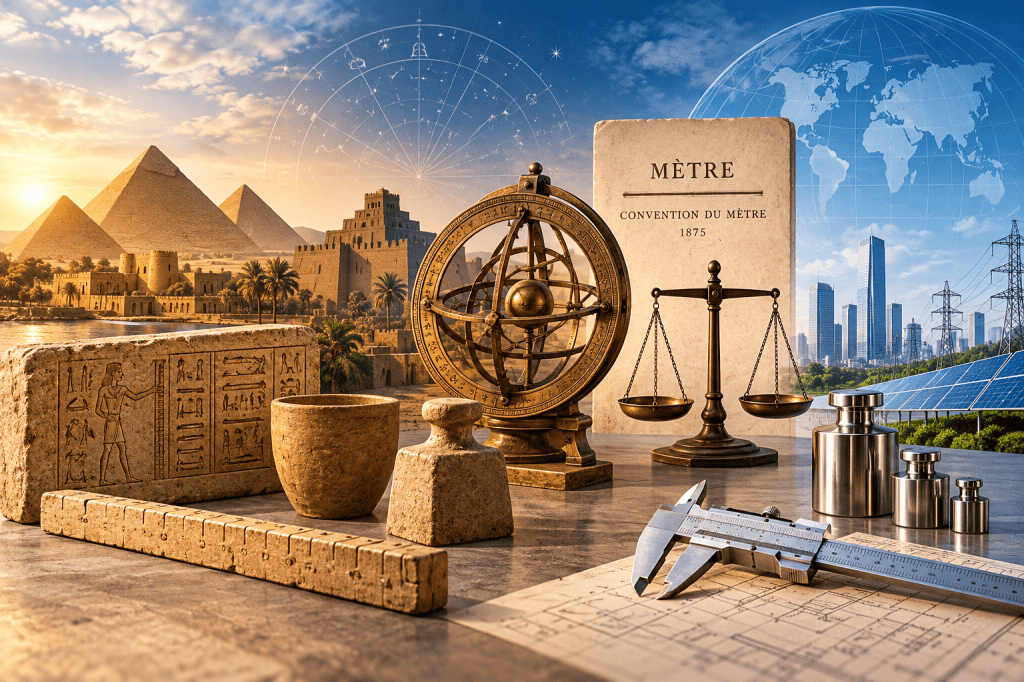
Mesopotamia and ancient Egypt provide important examples of early measurement practices.
Mesopotamian societies developed systems for measuring length, area, capacity, and mass.
Ancient Egyptian builders used standardized units such as the cubit to support construction.
These systems demonstrate that measurement standardization existed long before modern scientific institutions.
Timekeeping: One of Humanity’s Earliest Measurement Challenges
Understanding time was essential for agriculture, religious observances, trade, and government administration.
Early societies observed the movement of the Sun, Moon, and stars to organize calendars.
Mesopotamian mathematical traditions contributed to the development of sexagesimal, or base-60, numerical methods.
Elements of this tradition remain visible in modern timekeeping, including 60 seconds per minute and 60 minutes per hour.
From Local Standards to International Measurement
For much of history, different regions maintained their own measurement systems.
A unit of length used in one country might not equal a similarly named unit elsewhere.
As trade expanded, these differences became increasingly inconvenient.
Over time, governments and scientific communities worked toward more consistent measurement systems.
The development of the metric system and the signing of the Metre Convention in 1875 became major milestones in international measurement cooperation.
Measurement in the Modern World
Today, measurement is essential to nearly every technical industry.
In electrical engineering, engineers measure voltage, current, resistance, power, energy, and frequency.
Electricity meters measure energy consumption for billing and energy management.
Calibration laboratories establish confidence in measuring instruments through comparison with suitable references.
Modern technologies such as smart grids, Advanced Metering Infrastructure, and electric vehicle charging systems continue to create new measurement challenges.
Conclusion
The history of metrology is closely connected to the history of civilization itself.
What began with practical needs for trade, agriculture, construction, and timekeeping eventually developed into a global scientific measurement system.
Understanding this history helps engineers appreciate why measurement standards remain essential today.
At PT Equipower Corp Indonesia, we recognize reliable measurement as a foundation of engineering progress, industrial development, and trustworthy electrical energy systems.
Primary source: Edward C. Otte, “The History of Metrology,” TESCO Metering, July 22, 2024, pages 3–4. Adapted and expanded for educational purposes.


Leave a Reply